Celtic Cross Spread Guide: How to Read the 10-Card Tarot Layout
June 26, 2026 | By Aria Campbell
The Celtic Cross spread is one of the best-known tarot spreads because it gives a wide view of a question without forcing the reader into a single yes-or-no answer. Instead of looking at one card in isolation, the traditional Celtic Cross spread uses ten positions to explore the present situation, challenge, background, direction, inner motives, outside influences, hopes, fears, and possible outcome. If you are still building confidence, a free online tarot card generator can help you practice short pulls before you move into a full ten-card layout. Think of the Celtic Cross as a structured reflection map: detailed enough for complex questions, but still flexible when read with care.
What the Celtic Cross Spread Is Used For
A Celtic Cross tarot spread is useful when a question has several moving parts. It is often too much for a quick daily card and too layered for a simple past-present-future reading. The spread can help you examine what is happening now, what is crossing the issue, what shaped it, what may be developing, and how your own approach fits into the wider environment.
Use it for questions such as:
- "What should I understand about this career transition?"
- "What patterns are showing up in this relationship?"
- "What is influencing my next creative decision?"
- "What do I need to reflect on before choosing a direction?"
Try to avoid using the Celtic Cross spread as a command machine. Tarot is better treated as a reflective tool, not a substitute for medical, legal, financial, or professional advice. A strong reading gives language to possibilities, tensions, and choices. It does not remove your responsibility to think, ask follow-up questions, and act with judgment.
Celtic Cross Spread Layout and Position Meanings
Most readers use the Celtic Cross as a 10-card Celtic Cross tarot spread. The first six cards form the cross, and the last four cards form a vertical staff. Different traditions may change the order or labels, but the core idea stays similar: the cross shows the heart of the matter, while the staff shows personal stance, outside context, hopes or fears, and outcome.
| Position | Common meaning | How to read it |
|---|---|---|
| 1. Present | The current situation | Start with what is most active right now. |
| 2. Challenge | What crosses the issue | Look for pressure, friction, or the lesson in front of you. |
| 3. Foundation | Root cause or deeper base | Ask what is underneath the visible situation. |
| 4. Recent past | What is fading or still echoing | Notice what has shaped the current mood. |
| 5. Conscious focus | Goal, hope, or visible aim | Read what the querent thinks they want or expects. |
| 6. Near future | The next likely development | Treat this as movement, not a final verdict. |
| 7. Self | Your stance or role | Look at attitude, identity, behavior, or self-image. |
| 8. Environment | Outside influences | Consider people, conditions, timing, or shared context. |
| 9. Hopes and fears | Emotional tension | This card may show both desire and anxiety at once. |
| 10. Outcome | Likely direction | Read it as a possible result if the pattern continues. |
The position meanings matter, but the spread becomes more useful when you compare cards. A difficult card in the outcome position may soften if the advice implied by position 7 is clear. A hopeful card in position 5 may need grounding if position 6 shows a delay. The spread is less about memorizing ten definitions and more about reading a story across ten points.
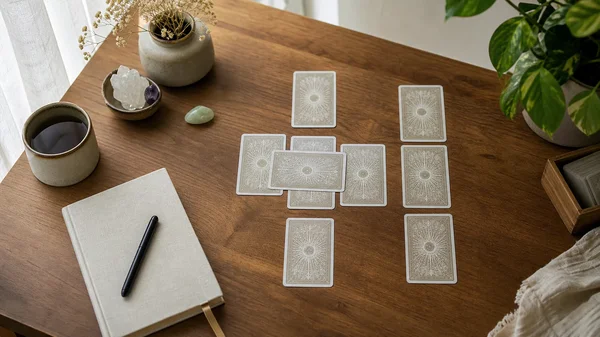
How to Read the Celtic Cross Spread Without Getting Lost
The easiest way to read the Celtic Cross spread is to move in layers. Do not try to solve every card at once. Begin with a clear question, shuffle with that question in mind, lay out the cards, and then read from the center outward. If you want a lighter practice round first, practice short tarot readings with one or three cards and notice how position changes affect meaning.
First, read cards 1 and 2 together. This pair gives the central tension: what is happening and what is crossing it. A bright card in the challenge position is still a challenge. It may show too much optimism, an expectation that needs testing, or a strength that has become unbalanced.
Second, read the vertical and horizontal lines of the cross. Cards 3, 1, and 5 can show depth, present awareness, and conscious aim. Cards 4, 1, and 6 can show movement from recent influence to next development. This is where the Celtic Cross spread meaning becomes richer than a list of card meanings.
Third, read the staff. Cards 7 through 10 show the reader how the querent stands in relation to the situation. Position 8 is especially important because it reminds you that no question exists in a vacuum. Other people, schedules, limits, expectations, and emotional climates can all affect the reading.
Fourth, compare useful pairs:
- Card 5 and card 6: Does the conscious goal match the near future?
- Card 7 and card 8: Is the querent's approach aligned with the environment?
- Card 6 and card 10: How does the next step feed the larger direction?
- Card 9 and card 10: Are hopes or fears shaping the outcome story?
Finally, summarize the spread in two or three plain sentences. A good Celtic Cross interpretation should be readable without sounding dramatic. For example: "The current issue is not lack of opportunity, but uncertainty about which responsibility matters most. The next step is to narrow the question, communicate expectations, and avoid treating a temporary delay as a permanent answer."
Traditional, Mini, 5-Card, 6-Card, and 11-Card Variations
The traditional Celtic Cross spread uses ten cards, but searchers often look for a 5 card Celtic Cross spread, 6 card Celtic Cross spread, mini Celtic Cross spread, or 11 card Celtic Cross spread. These variations can be useful, especially for beginners, as long as you know what you are simplifying.
A mini Celtic Cross spread usually keeps the center of the reading: present, challenge, foundation, direction, and advice. A 5-card version can work well when you want the shape of the cross without the full staff. A 6-card version may add a near-future or outcome card so the reading has a clearer sense of movement. These shorter layouts are easier to journal and less likely to overwhelm a new reader.
An 11-card Celtic Cross spread often adds a clarifier. The extra card may clarify the outcome, the advice, or the relationship between two confusing positions. Use clarifiers sparingly. If every difficult card gets another card, the spread can become messy. A clarifier is most helpful when you can name exactly what you are clarifying before you draw it.
There is no single "correct" Celtic Cross spread for every reader. The traditional layout is a strong foundation because it is widely recognized and easy to compare with books or guides. Variations are best used when they make the reading clearer, not when they help you avoid a card you do not like.
Questions That Work Well for a Celtic Cross Reading
The best questions for Celtic Cross spread readings are open, specific, and reflective. Since the spread looks at several layers, it works better with "What should I understand about..." than with "Will this happen by Friday?"
Strong questions include:
- "What do I need to understand about this decision?"
- "What is influencing this relationship pattern?"
- "How can I approach this transition with more clarity?"
- "What is the deeper lesson in this creative block?"
- "What should I reflect on before I respond?"
Love and relationship questions can work, but keep them grounded. Instead of asking the spread to define another person's private feelings as fact, ask what dynamics are visible, what you can learn, and what choices are within your control. For career, money, health, or legal concerns, keep the reading reflective and seek qualified support when the situation requires expert advice.
Reading the Celtic Cross With Online Tarot Tools
Many people search for Celtic Cross tarot online, a free Celtic Cross tarot reading, or a Celtic Cross tarot calculator because they want structure without setting up a physical deck. Online tools can be useful for learning, but the most important skill is still interpretation. A digital card pull can give you a card and meaning, but you still need to connect the card to the position, question, and surrounding cards.
For a full Celtic Cross, write the ten positions in a notebook or document, then record each card in order. Read the spread slowly. If you use a digital tool that offers shorter pulls, treat it as a warm-up, a clarifier, or a daily practice. One card can help you name the tone of the day. Three cards can help you explore a small sequence before you attempt the larger ten-card pattern.
This is where a simple tool can support the learning process. A digital tarot pull for reflection can help you practice reading upright and reversed meanings, notice card combinations, and save a result for later review. The key is to stay curious rather than force certainty. The Celtic Cross is strongest when it helps you ask better questions.

Build a Clear Celtic Cross Practice
If you are new to the Celtic Cross spread, begin with the traditional 10-card version, but give yourself permission to read it slowly. Write down the question, list the position meanings, and leave space for first impressions, card keywords, and pair comparisons. After the reading, add a short reflection: what felt clear, what felt unresolved, and what action or journaling prompt would be useful next.
You can also rotate between spread sizes. Use a one-card pull for daily tone, a three-card spread for quick context, and the Celtic Cross when the question deserves more depth. For a low-pressure warm-up before a longer reading, explore an intuitive tarot card generator and then bring that same reflective mindset to your larger layout. Over time, the Celtic Cross becomes less intimidating because you are no longer reading ten separate cards. You are reading one connected conversation.
FAQ
What is a Celtic Cross spread?
A Celtic Cross spread is a traditional tarot layout that usually uses ten cards. Each card has a position meaning, such as present situation, challenge, foundation, near future, self, environment, hopes and fears, and outcome. It is designed for layered reflection rather than quick yes-or-no answers.
How many cards are in a traditional Celtic Cross spread?
The traditional Celtic Cross spread has ten cards. Some readers use 5-card, 6-card, mini, or 11-card variations, but the classic structure is the 10-card Celtic Cross spread.
Is the Celtic Cross spread good for beginners?
It can be useful for beginners, but it is more complex than a one-card or three-card spread. Beginners may want to learn the position meanings first, then practice reading card pairs before trying to interpret the whole layout at once.
What questions should I ask a Celtic Cross spread?
Ask open questions that need context, such as "What should I understand about this decision?" or "What pattern is influencing this situation?" Avoid questions that demand certainty or try to replace practical judgment.
What is the difference between a Celtic Cross spread and a three-card spread?
A three-card spread is shorter and easier to read. It often looks at a simple sequence, such as past, present, and future. The Celtic Cross spread is broader because it includes internal motives, external influences, hopes, fears, and a possible outcome.
Can I do a Celtic Cross tarot reading online?
Yes, you can record a Celtic Cross layout online if your tool supports enough card positions, or you can use digital pulls and write the positions yourself. The important part is reading each card in relation to its position and the whole spread.