Cyberpunk Tarot Cards: Meanings, Locations, Rewards, and the 2026 Deck
June 12, 2026 | By Aria Campbell
Cyberpunk tarot cards are more than collectible wall art in Night City. In Cyberpunk 2077, they work as a visual trail through V's story: glitching murals, Major Arcana symbols, ending hints, and a quiet bridge between Misty's spirituality and the game's sharp sci-fi world. If you found one card and wondered whether the whole quest is worth finishing, the short answer is yes, especially if you like story clues, apartment memorabilia, and tarot symbolism. For readers who want to compare the game's cards with a simple real-world pull, a free online tarot card reading tool can make the same symbols easier to explore without turning them into fixed predictions.
What Cyberpunk Tarot Cards Are in the Game
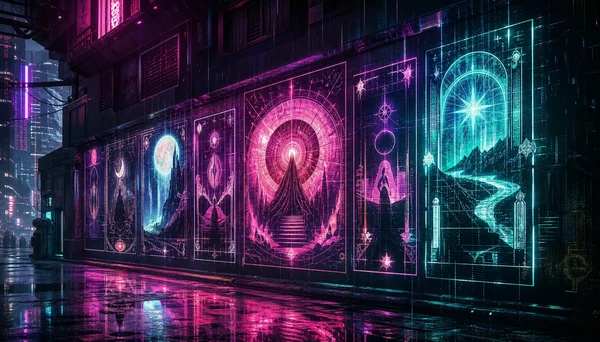
In the base game, the cyberpunk tarot cards are large digital graffiti murals that appear after Act 2 begins. They are part of the side job "Fool on the Hill," and they only become meaningful once V's situation with Johnny Silverhand is underway. The murals are not ordinary collectibles sitting on shelves. They are scanned pieces of environmental art, usually attached to story-heavy places: V's apartment, Misty's rooftop, Konpeki Plaza, Embers, the Columbarium, Arasaka Tower, and other charged locations.
Most of the base-game set is built around the Major Arcana, the twenty-two named cards often used to describe a symbolic journey: The Fool, The Magician, The High Priestess, The Emperor, Death, The Tower, The Star, The World, and so on. Cyberpunk 2077 uses that structure in a narrative way. The cards point less toward fortune-telling and more toward character themes, choices, turning points, and the uneasy question of who V is becoming.
That is why the quest feels different from a standard map cleanup task. The cards reward attention. The Fool beside V's apartment frames V as the traveler at the start of a dangerous journey. The Magician near Lizzie's Bar sits close to the chain of events that sets the heist in motion. Death near Embers appears where the story begins to move toward its final reckoning. Even if you do not read tarot in daily life, the murals give the main story a second symbolic layer.
Cyberpunk Tarot Cards Locations: How Many You Actually Need
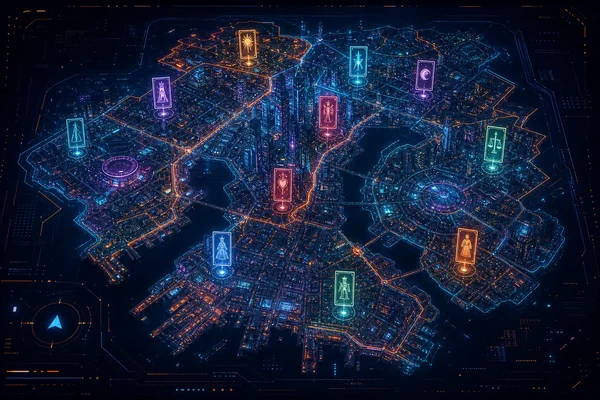
For the "Fool on the Hill" quest, you need to scan 20 tarot cards in the base game. These are the collectible murals that count toward the side job and the Wandering Fool achievement or trophy. The in-game map can help, but there is a catch: tarot icons appear only after you have been near enough to reveal them, and filtering the map to tarot cards makes the search much easier.
A practical way to collect them is to move district by district instead of chasing the Major Arcana order. Watson has early cards around V's apartment, Misty's area, Tom's Diner, and Lizzie's Bar. Westbrook and City Center include cards tied to Japantown, North Oak, Konpeki Plaza, and Arasaka spaces. Santo Domingo, Pacifica, the Badlands, and the oil fields hold several of the more spread-out murals. This is why players often search for "all tarot cards Cyberpunk map" after the last few icons become annoying to track.
Several specific searches deserve quick clarification. The Lovers card is at the Silver Pixel Cloud drive-in theater in North Oak, behind the screen. Many players look up the cyberpunk tarot card door code because the drive-in area can be locked; the commonly used code is 0000, which is found through the local computer/messages route in that area. The Death card is on a billboard near Embers. The World is near Misty's rooftop elevator area. The North Oak tarot card is usually The Lovers at the drive-in, not a separate hidden Major Arcana card.
Phantom Liberty adds four Dogtown tarot cards: King of Cups, King of Pentacles, King of Wands, and King of Swords. These are Minor Arcana court cards rather than part of the original 20-card "Fool on the Hill" checklist. They matter for expansion flavor and for Misty's added interpretations, but they should not be confused with the base-game quest requirement.
Cyberpunk Tarot Cards Reward, Secret Cards, and Missing Slots
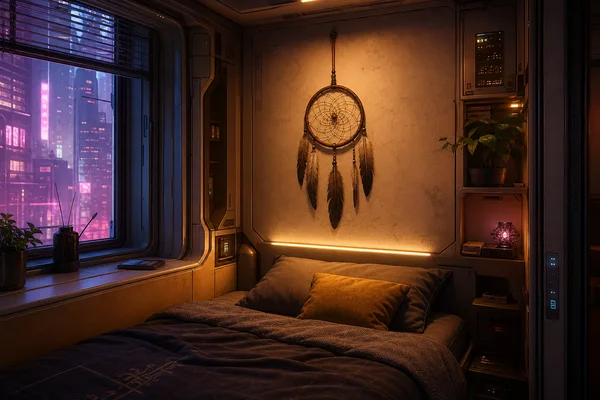
The main reward for finding all 20 base-game cyberpunk tarot cards is modest but memorable. After scanning the required murals, return to Misty. Completing the quest unlocks The Wandering Fool achievement or trophy and gives V Misty's dreamcatcher, which appears as apartment memorabilia above the bed in Megabuilding H10.
So, is it worth collecting the tarot cards in Cyberpunk? It depends on what you value. If you are looking for a combat perk, eddies, or a powerful weapon, the reward will feel small. If you care about the apartment, achievements, Misty's reading, and the game's symbolic storytelling, it is absolutely worth doing. The quest is one of the cleaner ways Cyberpunk 2077 ties exploration to theme.
The "two missing tarot cards" question comes from Judgement and The Devil. These are not part of the 20 required murals for "Fool on the Hill." They are tied to ending sequences instead of free-roam exploration. Judgement appears during endings that involve the assault on Arasaka Tower and the Adam Smasher fight. The Devil is tied to accepting Hanako Arasaka's help and the Arasaka ending path. Because endings branch, players can see why the collection screen can feel incomplete even after the quest reward is done.
The Phantom Liberty King cards are a separate case. They can be found in Dogtown and discussed with Misty, but they do not replace the two missing Major Arcana cards and should not be treated as the same reward path. Think of them as expansion-era symbolic additions rather than a fix for the base game's missing slots.
Cyberpunk Tarot Cards Meaning: The Fool's Journey in Night City
The meaning of the cyberpunk tarot cards works on two levels. First, each card carries a traditional tarot idea. The Fool suggests beginnings, risk, openness, and stepping into the unknown. The Magician suggests agency, talent, and the ability to shape a situation. The Chariot is about momentum and control. The Tower is sudden collapse. The Star is hope after disaster. The World is completion and the end of a cycle.
Second, Cyberpunk 2077 adapts those meanings into places and characters. The game does not simply paste tarot art onto walls; it places cards where their themes can echo the story. The Fool near V's apartment marks the beginning of the changed life. The Emperor near Konpeki Plaza points toward Arasaka power, control, and inheritance. The High Priestess near the apartment used in "Search and Destroy" speaks to secrets, withheld truth, and intuition. Temperance at the Columbarium naturally leans into memory, grief, and the question of what remains.
This is also why many players connect the cards to Cyberpunk endings. Several endings are named after tarot concepts, including The Sun, The Star, Temperance, The Devil, and The Tower. The naming is not accidental window dressing. It gives each ending an interpretive mood: glory, hope, surrender, uneasy bargain, or rupture. Tarot language lets the game speak about V's choices without reducing them to a simple good/bad scoreboard.
The best way to read the murals is not to ask, "What exact event does this card predict?" A better question is, "What tension does this card reveal in this place?" That keeps the cards useful without making them rigid. Tarot works best as a language of reflection, and Cyberpunk 2077 uses it as a language for narrative pressure.
Buying the Cyberpunk Tarot Deck: Dark Horse, Amazon, and Merch Notes
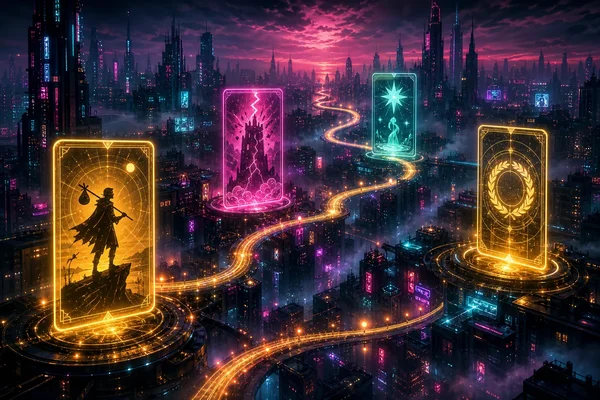
Searches for "Cyberpunk 2077 tarot cards buy," "Cyberpunk tarot cards Amazon," and "Cyberpunk tarot cards Dark Horse" usually point to the official Cyberpunk 2077: Tarot Deck & Guidebook. Current product listings describe it as a full 78-card tarot deck with a 128-page guidebook, deluxe box, and new art by Jakub Rebelka, created through Dark Horse Comics, CD PROJEKT RED, and Panini.
This real-world deck is different from the in-game mural checklist. The game quest mainly sends you after Major Arcana-style graffiti, while the physical deck is presented as a complete tarot deck for actual readings, including Minor Arcana cards. That distinction matters if you are buying it as merch: you are not just getting screenshots of the 20 murals. You are getting a broader Cyberpunk-themed tarot product intended to work as a deck.
Because availability, ship windows, and retailers can change, treat any buy page as time-sensitive. Check the official store listing, retailer details, edition information, shipping timing, and whether the page says preorder, in stock, low stock, or sold out. Avoid assuming that every marketplace listing is official, especially if pricing looks inflated or the product images do not match the published deck and guidebook details.
If you want to understand the card structure before buying a deck, using a simple tarot card generator can help you learn how a single card or three-card spread feels in practice. It will not duplicate Night City's art, but it can make the underlying tarot language clearer.
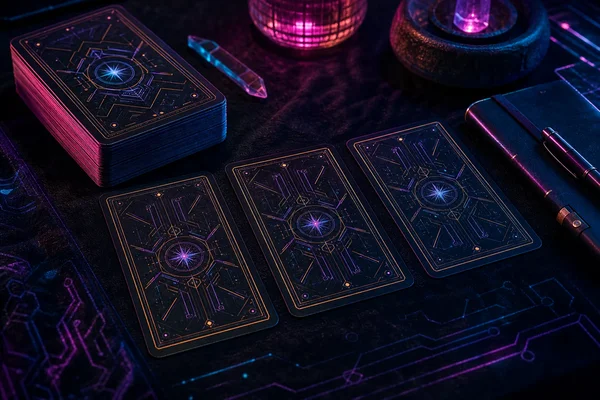
Turn Cyberpunk Tarot Cards Into a Real-World Reflection Ritual
The smartest way to bring cyberpunk tarot cards into real life is to use them as prompts, not verdicts. Cyberpunk 2077 makes tarot feel compelling because the cards sit beside choices, losses, alliances, and identity shifts. A personal reading can work the same way when it asks a better question.
Try a three-step reflection after you collect or revisit a card. First, name the card and the scene where it appears. Second, write the tension it seems to highlight: control versus freedom, hope versus fear, memory versus reinvention, loyalty versus survival. Third, ask a grounded reflection question such as, "Where am I trying to force control?" or "What ending am I afraid to choose?" This keeps the experience thoughtful without pretending that a card can decide your life for you.
For a light version, pull one card and compare it with a Cyberpunk mural you remember. For a fuller version, use a three-card spread: what is changing, what is resisting change, and what helps you move with more clarity. A reflective digital tarot spread is enough for this kind of practice because the point is not theatrical certainty. The point is noticing patterns, language, and choices with a little more imagination.
FAQ
Is it worth collecting the tarot cards in Cyberpunk?
Yes, if you enjoy exploration, achievements, apartment memorabilia, and story symbolism. The direct reward is not a major gameplay upgrade, but completing the 20 base-game cards gives you The Wandering Fool achievement or trophy and Misty's dreamcatcher for V's apartment.
What is the point of tarot cards in Cyberpunk?
The tarot cards give Cyberpunk 2077 a symbolic layer. They connect locations, characters, and endings to Major Arcana themes such as beginnings, control, collapse, hope, temptation, and completion. They also support Misty's role as someone who reads V's journey through signs rather than pure data.
Do you get anything for finding all the tarot cards in Cyberpunk?
For the base-game "Fool on the Hill" set, yes. After scanning all 20 required murals and returning to Misty, you receive the Wandering Fool achievement or trophy and a dreamcatcher decoration for V's apartment. The Phantom Liberty King cards add interpretation, but they do not appear to give the same kind of reward.
Why are two tarot cards missing in Cyberpunk 2077?
The two commonly missing cards are Judgement and The Devil. They are not part of the 20-card free-roam quest requirement. Judgement is tied to Arasaka Tower assault ending content, while The Devil is tied to the Hanako Arasaka ending path. That is why the collection can look incomplete after "Fool on the Hill" is finished.
What does each tarot card represent in Cyberpunk?
Each card blends a traditional tarot idea with a Cyberpunk 2077 story location. The Fool represents V's dangerous beginning, The Emperor points toward Arasaka power, Death marks transformation and finality, The Tower signals collapse, and The Star suggests hope after upheaval. The meaning is strongest when read beside the scene where the mural appears.
Are the Cyberpunk tarot cards a real deck?
The in-game cards are murals and story symbols, but there is also an official Cyberpunk 2077: Tarot Deck & Guidebook listed as a physical 78-card deck with a guidebook. The physical deck is merch for real readings and collecting, while the in-game murals are tied to quests, locations, and endings.