Tarot Card Dimensions: Size, Ratio, Pixels, and Print Basics
October 15, 2026 | By Aria Campbell
Tarot card dimensions matter more than they first appear. The size of a card affects how artwork feels, how easily a deck shuffles, how much table space a spread needs, and what pixel canvas a designer should use for printing. If you are comparing a physical deck with an online reading, the numbers can also explain why tarot cards feel taller and more image-focused than ordinary playing cards. Before you choose a template or sketch a deck idea, it helps to understand the standard size, the common alternatives, and how those measurements translate into pixels. For a quick reading experience that does not require a physical deck, you can also explore a digital tarot card pull while you learn the basics.
Standard Tarot Card Dimensions
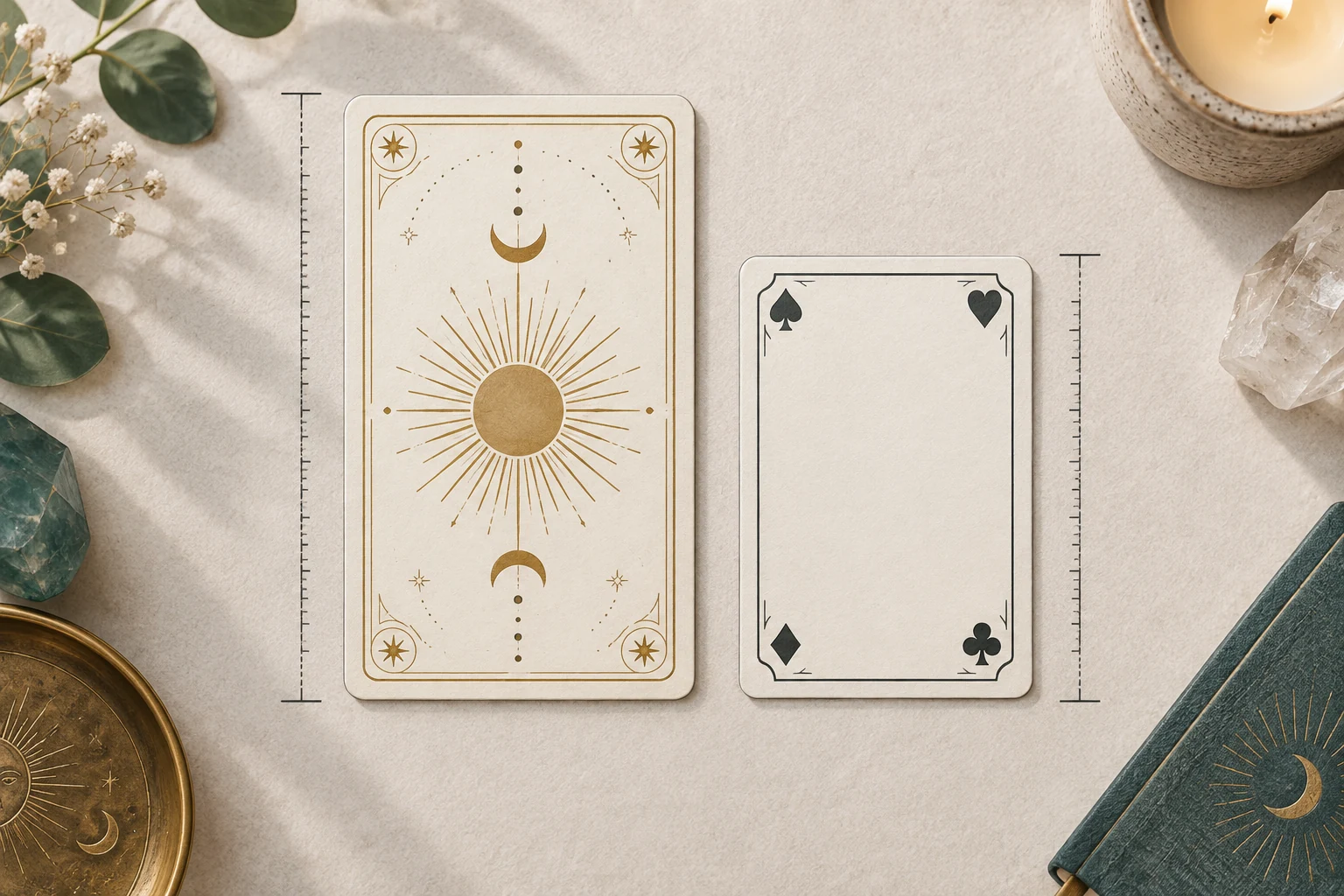
The most common tarot card size is about 2.75 x 4.75 inches, which is approximately 70 x 120 mm or 7 x 12 cm. You will often see slight rounding differences because printers, regions, and publishers may express the same size in different systems. A deck may be listed as 70 x 121 mm, 2.75 x 4.75 inches, or simply "standard tarot size," and still feel familiar in the hand.
This format is noticeably taller than a poker card. A standard poker card is usually about 2.5 x 3.5 inches, so tarot gains only a little width but more than an inch of height. That extra height is useful because tarot artwork often carries symbols, figures, landscapes, titles, numbers, suit signs, and small visual details. The format gives each card enough room to behave like a small scene rather than a compact game token.
The standard size is also practical. It is large enough for imagery to breathe, but still small enough for most readers to shuffle, fan, and lay out in a three-card spread. If you are unsure which size to use for a personal deck, a study deck, or a simple printable template, standard tarot dimensions are usually the safest starting point.
Tarot Card Size in Inches, Centimeters, and Millimeters
Here is a quick reference for the sizes people most often compare:
| Card type | Inches | Millimeters | Centimeters | Typical use |
|---|---|---|---|---|
| Mini tarot | 1.75 x 3 to 2.25 x 3.5 | about 44 x 76 to 57 x 89 | about 4.4 x 7.6 to 5.7 x 8.9 | Travel, small hands, quick draws |
| Standard tarot | 2.75 x 4.75 | about 70 x 120 | about 7 x 12 | Most published tarot decks |
| Large tarot | 3 x 5 to 3.5 x 5.5 | about 76 x 127 to 89 x 140 | about 7.6 x 12.7 to 8.9 x 14 | Display, teaching, detailed art |
| Poker card | 2.5 x 3.5 | about 64 x 89 | about 6.4 x 8.9 | Playing cards and many game decks |
| Trading card | 2.5 x 3.5 | about 64 x 89 | about 6.4 x 8.9 | Collectible and game cards |
The table shows why "card size" is not one universal answer. Tarot cards, poker cards, trading cards, and magic-style game cards may look similar in photos, but their proportions create different handling experiences. A tarot deck is usually taller because it needs a portrait canvas for symbolic art. A poker deck is shorter because fast shuffling, dealing, and one-handed handling matter more.
If you are buying sleeves, boxes, or storage cases, always check the exact product dimensions instead of relying only on the phrase "standard card size." A sleeve made for poker cards may be too short for tarot. A box made for a large tarot deck may leave a standard deck sliding around unless it has inserts.
Tarot Card Size Ratio and Why It Looks Tall
The standard tarot card size has an approximate ratio of 2.75:4.75, which simplifies to about 1:1.73 when width comes first. In design terms, the card is a tall rectangle. This shape suits tarot because many cards depict standing figures, paths, pillars, cups, swords, celestial symbols, and vertical landscapes.
A poker card is closer to 1:1.4. That makes it easier to hold, stack, and deal quickly, but it gives less vertical storytelling space. Tarot readers tend to study images more slowly, so the taller ratio invites the eye to move through a scene from foreground to sky, from title to figure, or from symbol to symbol.
This is also why shrinking a tarot card is not always as simple as scaling the art down. Thin linework, tiny symbols, and small titles can become hard to read on mini cards. When a deck becomes larger, the opposite problem can appear: wide borders, simple artwork, or low-resolution files may start to feel empty or blurry. Good tarot card dimensions balance three things at once: artwork detail, hand comfort, and the purpose of the deck.
Size of Tarot Cards in Pixels
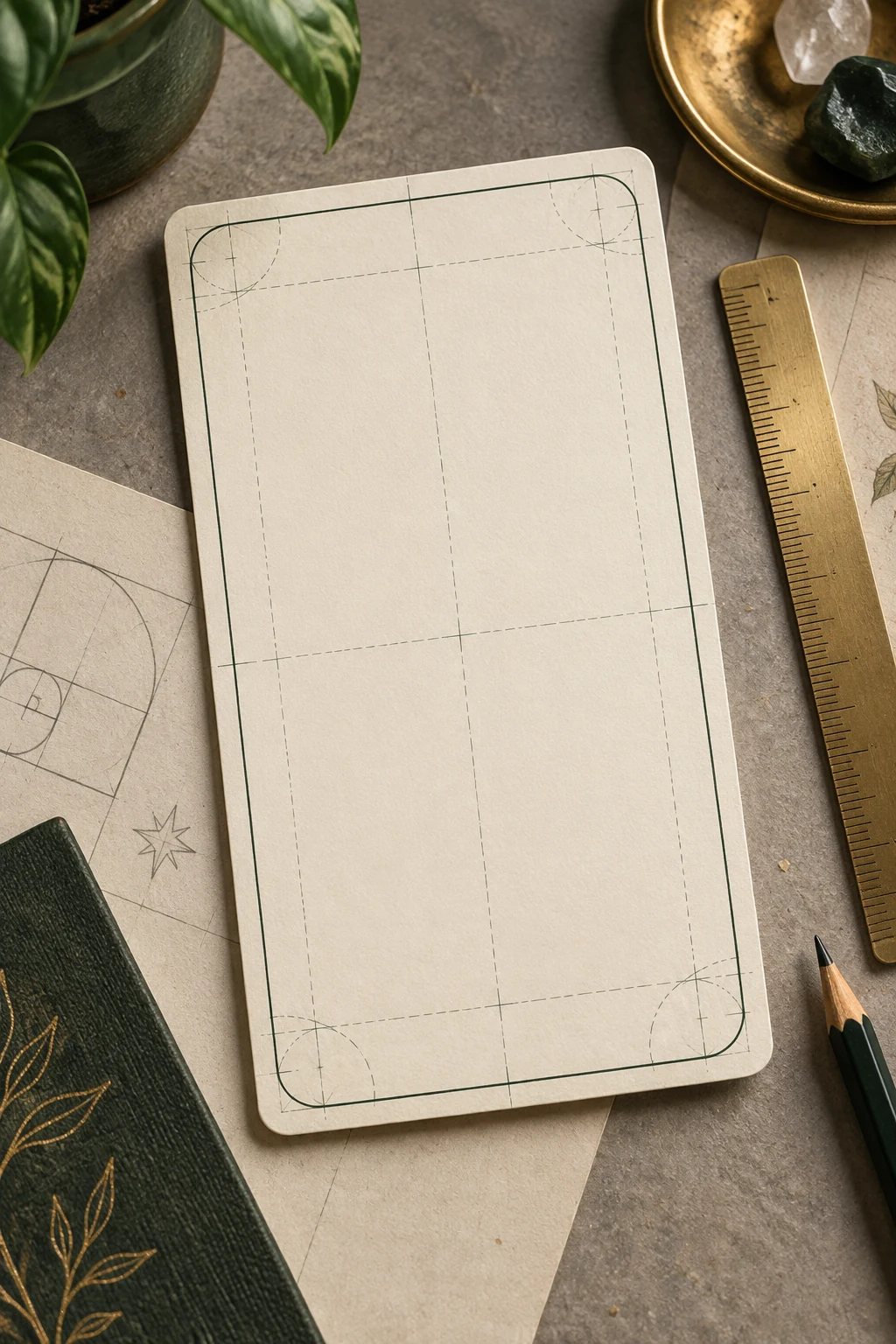
Pixel dimensions depend on resolution. For print, the common target is 300 DPI, which means 300 pixels for each printed inch. A finished standard tarot card at 2.75 x 4.75 inches therefore needs about:
| Print area | Calculation | Pixel size |
|---|---|---|
| Finished standard card | 2.75 x 300 by 4.75 x 300 | about 825 x 1425 px |
| Standard card with 0.125 inch bleed on each edge | 3.0 x 300 by 5.0 x 300 | about 900 x 1500 px |
| Large 3.5 x 5.5 inch card | 3.5 x 300 by 5.5 x 300 | about 1050 x 1650 px |
Some printers list a full-bleed canvas slightly differently, such as 897 x 1497 pixels, because their templates use metric measurements or a specific bleed value. That is normal. The important idea is that the print file should be larger than the final cut card when bleed is required.
For digital-only tarot artwork, pixels have a different purpose. You are no longer preparing paper for a cutting machine; you are preparing an image for screens. A card displayed in a browser can look clear at many sizes if the source file is large enough and the aspect ratio is preserved. For blog graphics, app mockups, or a personal digital journal, a 900 x 1500 px portrait image is often a comfortable working canvas because it keeps the classic tarot shape and leaves room for detail.
If you use a free tarot card generator, you do not need to calculate print pixels just to reflect on a question. Pixel dimensions matter most when you are designing, printing, scanning, or comparing card artwork. For ordinary readings, the more important question is whether the image is clear enough for you to notice the symbols and remember your response.
What a Tarot Card Template Should Include
A tarot card size template is more than a rectangle. A print-ready template usually includes at least three zones:
- Trim line: the final edge of the card after cutting.
- Bleed area: extra artwork that extends beyond the trim line so the card does not show white edges if the cut shifts slightly.
- Safe area: the inner zone where titles, numbers, faces, symbols, and important details should stay.
Many templates also include rounded corner guidance. Tarot cards often use rounded corners because sharp corners wear quickly and feel less comfortable during shuffling. A common corner radius sits around a few millimeters, but exact requirements depend on the printer.
If you are designing a deck, build the template before creating all 78 cards. It is painful to finish dozens of illustrations and then discover that titles sit too close to the edge or the border does not survive the trim. A simple habit helps: place essential details well inside the safe area, extend background art fully through the bleed, and export files according to your printer's specification.
For a digital tarot card size template, the same visual logic still helps even without physical cutting. Leave comfortable margins. Keep titles readable. Avoid putting important symbols so close to the edge that they disappear on small screens. Digital cards may not be trimmed, but they are often cropped, resized, compressed, or viewed on narrow mobile displays.
Rider-Waite Tarot Card Size and 78-Card Deck Context
Many people search for Rider Waite tarot card size because the Rider-Waite-Smith tradition shapes how modern readers imagine tarot. Deck editions vary by publisher and year, but standard Rider-Waite-style decks are commonly close to the familiar 2.75 x 4.75 inch tarot format. Some versions are pocket sized, some are oversized, and some modern editions adjust borders or cardstock while keeping the same general portrait feel.
The deck structure is usually more stable than the physical size. A traditional tarot deck has 78 cards: 22 Major Arcana cards and 56 Minor Arcana cards. The Minor Arcana is divided into four suits, often Wands, Cups, Swords, and Pentacles, with numbered cards and court cards. This card count affects packaging, thickness, guidebooks, and table layout. A large 78-card deck can feel beautiful but heavy; a mini 78-card deck can be portable but visually compressed.
When choosing dimensions, ask how the deck will be used. A study deck benefits from clear symbols and readable titles. A travel deck benefits from a compact size. A collector deck may justify a large format because the artwork is meant to be admired. A digital reading tool has a different advantage: it can present card imagery and interpretation without asking the user to carry, shuffle, sleeve, or store a physical deck.
Choosing Large, Mini, or Standard Tarot Cards
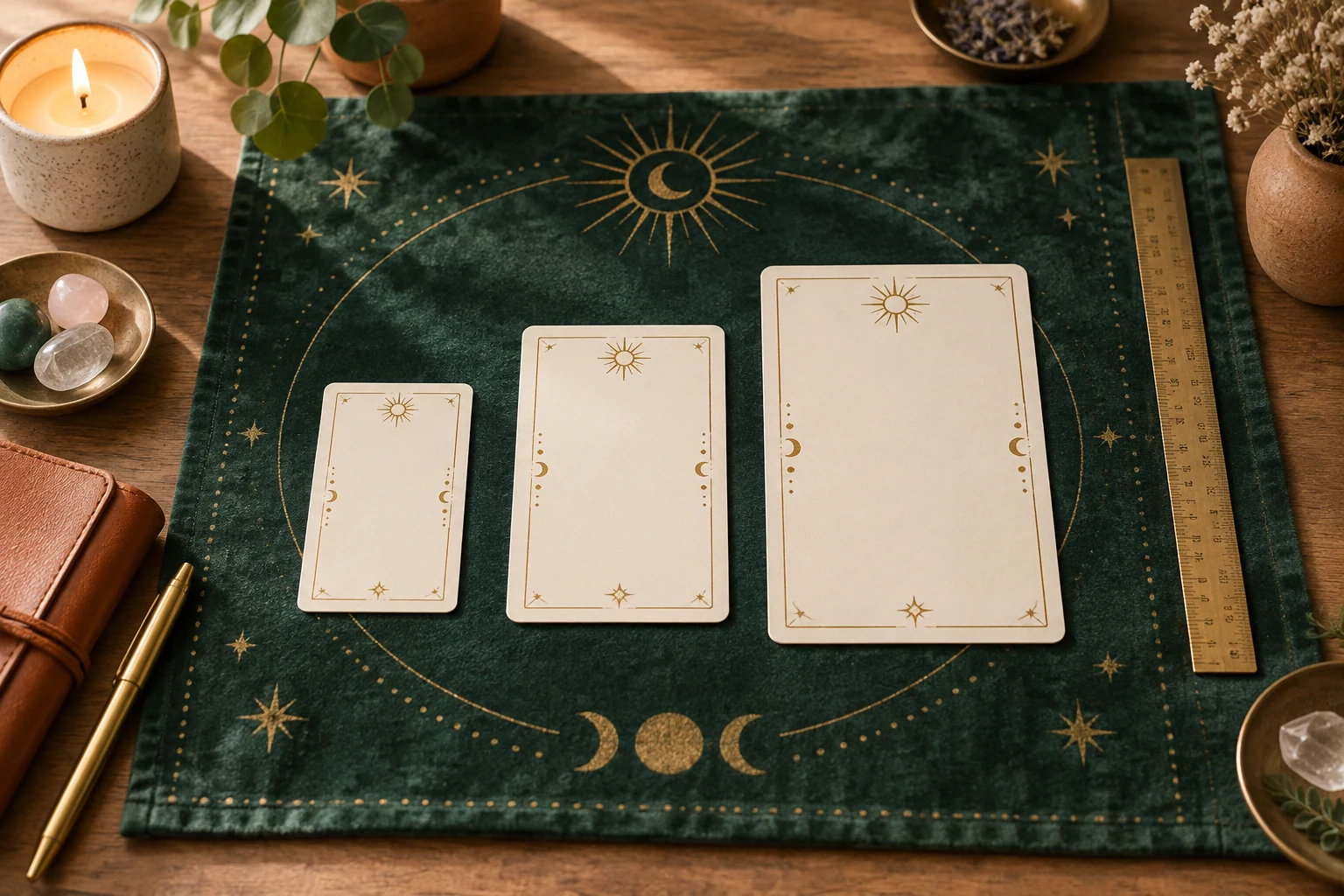
There is no single best tarot card size for every reader. Standard tarot dimensions are popular because they sit in the middle. They offer enough space for artwork and remain manageable for repeated shuffling. If you are buying your first physical deck, standard size is usually the easiest choice.
Mini tarot cards are helpful for travel, small reading spaces, daily one-card pulls, or readers who find full-size decks awkward. Their trade-off is legibility. Detailed scenes, small titles, and symbolic backgrounds can become harder to see. They are best when the artwork is bold and the user already knows the deck fairly well.
Large tarot cards are excellent for teaching, altar display, group readings, photography, or art-heavy decks. Their trade-off is handling. They may be harder to riffle shuffle, harder to store, and more expensive to print or sleeve. Large cards can also demand stronger image resolution because flaws become more visible.
If you are planning a deck, choose the size after you understand the artwork style. Delicate line art, ornate borders, and tiny symbolic details need more room. Minimal cards with strong icons can work beautifully in smaller formats. If you are choosing a deck to read with, think about your hands, your table, and whether you prefer a tactile ritual or a quick reflective moment.
Using Tarot Card Dimensions for Better Readings
Tarot card dimensions are practical, but they are also part of the reading experience. A card's size changes how slowly you look at it, how confidently you handle it, and how much space a spread occupies. For beginners, that can shape whether tarot feels welcoming or fussy.
If the numbers feel technical, keep the simple version in mind: standard tarot cards are about 2.75 x 4.75 inches, 70 x 120 mm, or 7 x 12 cm; the ratio is roughly 1:1.73; and a print-ready 300 DPI file is around 825 x 1425 px before bleed. Those figures are enough for most comparisons, sleeve checks, and early design decisions.
From there, let purpose lead. Use standard cards when you want a familiar all-around deck. Use mini cards for portability. Use large cards when artwork, teaching, or display matters more than easy shuffling. And when you want to focus on reflection rather than measurements, a gentle tarot reading tool can give you the card experience without requiring sleeves, boxes, printers, or a perfectly measured table.

FAQ
What is the typical aspect ratio of a tarot card?
A standard tarot card is roughly 2.75 x 4.75 inches, which creates an aspect ratio of about 1:1.73 when width comes first. This taller portrait shape gives tarot artwork more vertical room than a standard poker card.
What is the size of a tarot card?
The common standard tarot card size is about 2.75 x 4.75 inches, 70 x 120 mm, or 7 x 12 cm. Mini and large decks exist, so always check the exact dimensions before buying sleeves, boxes, or print templates.
What is the typical format of a tarot card?
Most tarot cards use a vertical portrait format with rounded corners, a front illustration, and a consistent card back. Print templates usually include trim, bleed, and safe-area guides so artwork and titles stay positioned correctly.
What are the standard dimensions for printing tarot cards?
For a standard deck, plan around 2.75 x 4.75 inches as the finished size. At 300 DPI, that is about 825 x 1425 pixels before bleed. If your printer requires 0.125 inch bleed on each edge, the file may be closer to 900 x 1500 pixels.
Are tarot cards bigger than playing cards?
Yes. A standard poker card is usually about 2.5 x 3.5 inches, while a standard tarot card is about 2.75 x 4.75 inches. Tarot cards are only slightly wider but much taller.
How many cards are in a tarot deck?
A traditional tarot deck usually has 78 cards: 22 Major Arcana cards and 56 Minor Arcana cards. Some oracle decks or special tarot-inspired decks use different counts, but 78 is the classic tarot structure.
What size should a tarot card template be?
Start with the finished card size, such as 2.75 x 4.75 inches, then add the bleed required by your printer. Keep important titles and symbols inside the safe area, and confirm whether the printer wants files in inches, millimeters, pixels, RGB, or CMYK.