Tarot Reading Journal Prompts for Safer Daily Reflection
March 21, 2026 | By Aria Campbell
Why journal prompts improve one-card tarot consistency
A one-card draw can feel clear in the moment and then fade by evening. That happens when the card is remembered, but the question, context, and interpretation are not recorded. A short journal prompt solves that gap by turning each draw into a traceable reflection.
This approach does not require a long ritual. It needs a stable structure that can be repeated on busy days. Open the one-card tarot workspace, write one focused question, draw once, and capture the result in a fixed note format.
Consistency matters more than volume. Five lines written every day are often more useful than one long entry written once a month. A fixed prompt also reduces hindsight rewriting, where old readings are remembered in a way that matches today instead of yesterday.
Tarot can support reflection, but it should not be used as medical, legal, or financial advice. Disclaimer: The information and assessments provided are for educational purposes only and should not replace professional medical advice, diagnosis, or treatment.
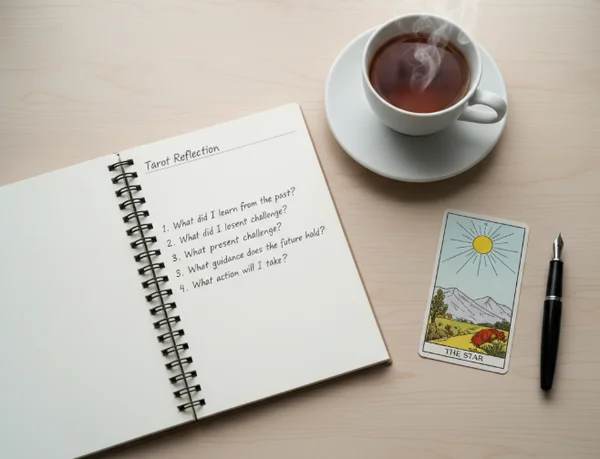
Build a one-card logging system in under ten minutes
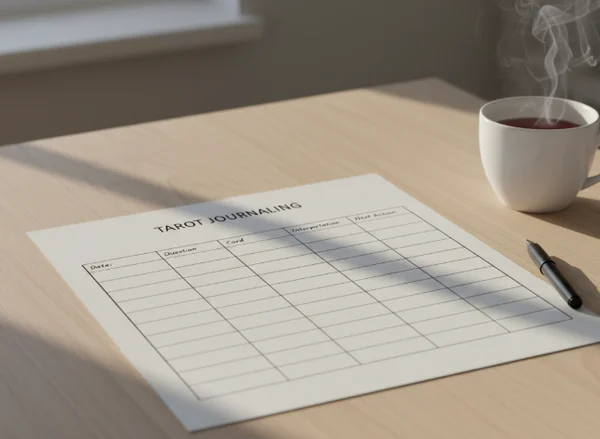
A simple entry template for question, card, and interpretation notes
Use one template for every entry. Keep it simple so the format never becomes a blocker.
- Date and time.
- Question in one sentence.
- Card drawn and upright or reversed status.
- First interpretation in plain language.
- One small action for the next 24 hours.
A short structure is easier to keep than a perfect structure. The goal is to build a clear chain from question to interpretation to action. That chain makes weekly review possible.
A useful timing benchmark comes from a PubMed-indexed writing trial that used 20-minute sessions across 3 consecutive days in a structured format (PubMed study protocol). Tarot journaling does not need to copy that exact protocol, but the study design shows that short, scheduled writing blocks are realistic for daily use.
If ten minutes is the true daily limit, split it into two blocks. Spend five minutes on the draw and first notes, then five minutes later in the day for outcome reflection. This keeps the habit stable even on high-workload days.
For readers who want broader context, occasional three-card check-ins can be logged in the same notebook. The same template still works if the spread is captured in separate lines and reviewed in the three-card spread view.
Daily prompt categories that prevent vague readings
Vague questions produce vague entries. Prompt categories help sharpen intent without forcing certainty.
Use four rotating categories through the week:
- Focus prompt: "Where should attention go today?"
- Friction prompt: "What pattern is making today harder than it needs to be?"
- Choice prompt: "What tradeoff is present in this decision?"
- Boundary prompt: "What limit should be protected this week?"
Each category produces a different lens. Over seven days, this gives a balanced journal instead of repeating the same question in different words.
After writing the interpretation, add one sentence that starts with "Evidence from today:". This sentence should name a real event, message, or behavior observed that day. It keeps the journal connected to reality and reduces projection.
Use boundaries when readings touch high-stakes life topics
Language patterns that keep journaling non-diagnostic and non-prescriptive
The wording inside a tarot journal changes how the entry feels later. Certain sentence patterns can keep reflection grounded and safe.
Prefer these forms:
- This card suggests a theme to explore.
- This interpretation is a prompt, not a final answer.
- This note supports reflection, not diagnosis.
Avoid these forms:
- This card proves what will happen.
- This means treatment is not needed.
- This reading settles the issue completely.
When entries involve intense distress, safety language should be direct. NIMH states that in life-threatening situations people should call 911 or go to the nearest emergency room (NIMH help guidance). If symptoms are severe or if symptoms persist, seek professional help rather than relying on card interpretation alone.
Boundaries protect the practice. They also protect trust in the tool. Tarot journaling works best when it supports observation and decision clarity, not when it tries to replace qualified care.
Weekly review method for spotting patterns without overclaiming certainty
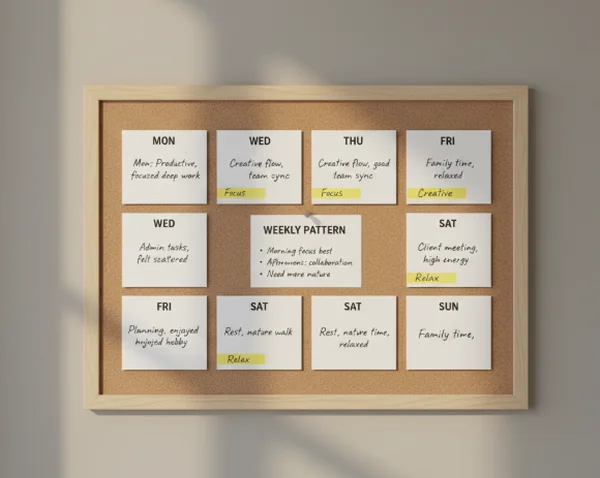
Set one review window each week, such as Sunday evening. Read the last seven entries in order and mark repeated themes. Look for language patterns, not fixed predictions.
Use this simple review sheet each week. Write one short line for each item.
- Most repeated prompt category
- Most repeated emotional tone word
- One recurring decision friction
- One action that was completed
- One action that was deferred
Treat repeated items as signals to explore, not fixed predictions.
This review process helps users notice patterns without claiming that a single card controls outcomes. If a week includes strong emotional distress, add a safety step in the journal footer with the national 988 contact from [SAMHSA's 988 guidance].
Pattern tracking is useful when it stays humble. A repeated symbol may indicate attention needs, not certainty. The journal is a mirror for reflection, not an authority over personal agency.
Keep all logs in one consistent place so month-to-month review is easy. The tarot reading archive tools can support this by pairing draw outputs with saved notes and recurring prompts.
Key takeaways and a repeatable seven-day journaling routine
A safer tarot journaling practice depends on structure, wording, and boundaries. Structure makes entries comparable. Wording keeps interpretation reflective instead of absolute. Boundaries keep high-stakes topics connected to real-world support options.
Use this seven-day routine: one card daily, one five-line entry per draw, one weekly review session, and one boundary check for high-stakes topics. This is enough to build continuity without overcomplicating the process.
Over time, the biggest value is pattern literacy. Users begin to see how questions evolve, which prompts produce better clarity, and where action follows insight. That turns tarot from a one-off moment into a steady reflection practice grounded in documented notes and safe decision boundaries.
If this process starts feeling heavy, reduce frequency for a week and keep entries shorter. Reflection quality matters more than streak length. A sustainable rhythm usually leads to clearer notes, cleaner weekly reviews, and better decisions about when a topic belongs in a journal versus when it needs outside support.