Yes/No Tarot Guide: Get Accurate Answers
January 26, 2026 | By Aria Campbell
Are you standing at a crossroads, needing a clear, straightforward answer? Many of us turn to tarot for guidance, but getting a simple "Yes" or "No" can feel surprisingly complex. How can you get clear guidance from the tarot for a binary decision?
Many people struggle with phrasing Yes/No questions correctly or feel confused by nuanced answers from a single card pull. This comprehensive guide is here to help. We'll walk you through the art of getting precise, actionable insights from Yes/No tarot readings. You'll learn how to ask the right questions and interpret the cards with confidence, and you can practice right away with our free tarot tool.

Mastering Yes/No Tarot Questions
The quality of your answer often depends on the quality of your question. A well-phrased question opens the door to clarity, while a poorly phrased one can lead to confusion. Let's explore how to formulate questions that invite direct and helpful responses from the tarot.
What Makes a Yes/No Question Effective
An effective Yes/No question is specific, focused on the near future, and within your control. It should be a closed-ended question that can logically be answered with a "Yes" or "No." The best questions empower you by focusing on actions and immediate possibilities, rather than asking the cards to predict a distant, unchangeable fate.
Here are some examples of effective questions:
- "Is pursuing this job opportunity in my best interest right now?"
- "Will I benefit from having an honest conversation with my partner this week?"
- "Is this the right time to start my creative project?"
These questions are clear, timely, and centered on your choices. They invite the tarot to provide guidance on a specific path, making the answer more actionable and relevant to your current situation.
Common Yes/No Question Mistakes to Avoid
To get the most out of your Yes/No reading, it's crucial to avoid certain types of questions that can muddy the waters. These mistakes often lead to ambiguous answers that leave you feeling more uncertain than before. Being mindful of these pitfalls is a key step in mastering tarot.
Here are common mistakes to steer clear of:
- Asking "Should I...?": This asks the tarot to make a decision for you. Instead, rephrase it to "Is it in my best interest to...?" to keep your personal power.
- Combining multiple questions: Avoid asking "Should I quit my job and start a business?" This is two questions in one. Ask about each part separately for a clearer answer.
- Asking about others' feelings: Questions like "Does he love me?" invade another person's privacy. A better question is, "Is there potential for our relationship to grow?"
- Asking for a specific timeline: Avoid questions like "Will I get a promotion in May?" The future is fluid. A better approach is, "Am I on the right track to get a promotion?"
By avoiding these mistakes, you set the stage for a more productive and insightful reading. For practice, you can try a single card reading with a well-formed question.
Interpreting Yes/No Tarot Answers
Once you've drawn a card, the next step is interpretation. While some cards seem like a clear "Yes" or "No," others carry more complex messages. Understanding the general energy of upright, reversed, and neutral cards is essential for accurate readings.
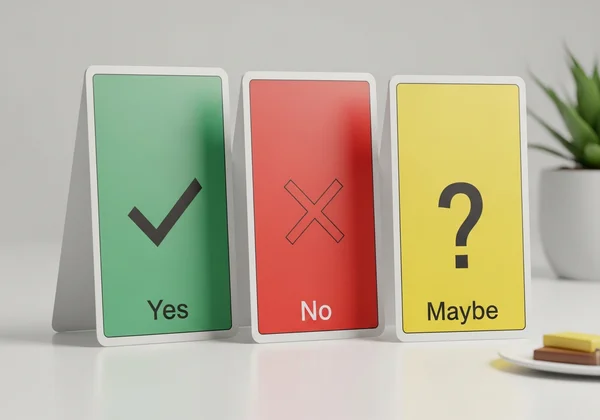
Reading Upright Cards as Yes/No Answers
In general, most upright cards with positive or proactive energy are interpreted as a "Yes." Cards like The Sun, The Star, The World, the Ace of Cups, or the Six of Wands all signal success, positivity, and forward movement. They suggest that the path you're asking about is clear and supported.
For example, drawing The Magician upright for the question "Is this a good time to launch my project?" is a resounding "Yes." It indicates you have all the resources and skills needed to succeed. Similarly, The Lovers would suggest a "Yes" for a question about strengthening a partnership. Learning the core meanings will help you quickly identify these positive signals.
Understanding Reversed Cards as "Maybe" or Conditions
Reversed cards often indicate a 'No,' 'Not right now,' or 'Maybe.' These cards typically point to blockages, delays, or suggest you should reconsider your approach. A reversed card doesn't always mean a hard 'No.' Often, it serves as a yellow light, urging you to proceed with caution and reflect.
For instance, drawing the Ten of Swords reversed might not be a simple "No." It could mean you are avoiding a necessary ending or that the worst is over. A reversed Chariot could signal a lack of control or direction, suggesting you should pause and regroup before moving forward. These cards ask you to look deeper at the conditions surrounding your question.
Neutral Cards and Their Dual Meanings
Some cards are inherently neutral or situational, meaning their Yes/No answer depends heavily on the context of your question. Cards like The High Priestess, Justice, or the Two of Swords don't lean strongly toward a "Yes" or "No." Instead, they point to a need for more information or a different perspective.
The High Priestess suggests that the answer is not yet known or that you should trust your intuition. Justice indicates that the outcome will be fair but depends on past actions and a balanced approach. The Two of Swords often means you are at an impasse or avoiding a decision. When you pull a neutral card, it's a sign to reflect on the question itself or explore the situation with a more detailed spread, like the three-card reading.
Advanced Yes/No Tarot Techniques
Once you're comfortable with the basics, you can explore advanced techniques to add depth and confidence to your Yes/No readings. These methods are perfect for when you need extra confirmation or a more nuanced understanding of the situation at hand.
Multi-Card Confirmation Methods
If a single card feels insufficient, using a three-card method can provide greater clarity. Draw three cards to answer your Yes/No question. The interpretation is simple:
- Three upright cards: A strong "Yes."
- Three reversed cards: A strong "No."
- Two upright, one reversed: A "Yes, but..." there are obstacles or considerations.
- One upright, two reversed: A "No, unless..." you address the significant challenges present.
This technique offers a more detailed picture, helping you understand the forces supporting or blocking your path. It's a fantastic way to move beyond a simple binary and get actionable advice.
Timing and Context in Yes/No Readings
Context is everything in tarot. A card's meaning changes based on context. In Yes/No readings, pay attention to the timing suggested by the cards. Wands often relate to quick action (days or weeks), Cups to emotional timelines (weeks or months), Swords to swift but challenging periods, and Pentacles to slower, more deliberate developments (months or years).
If you ask, "Will I finish my project soon?" and draw the Eight of Wands, that’s a clear "Yes" and suggests rapid progress. If you draw the Seven of Pentacles, the answer is likely "Yes," but it will require patience and sustained effort. Integrating this layer of timing can make your free tarot yes or no readings incredibly practical.
Your Path to Clear Yes/No Tarot Guidance
With these techniques in your toolkit, you're ready to get clear, accurate answers from your Yes/No tarot readings. The real magic of Yes/No tarot isn't just in getting an answer—it's in finding clarity and feeling empowered to move forward. When you learn to ask better questions and understand what the cards are telling you, tarot becomes your trusted companion for making decisions with confidence.
Ready to put these Yes/No tarot techniques into practice? Our free tarot card generator makes it simple to get instant, accurate answers to your most pressing questions. Try a single card reading now and experience the clarity that comes from properly framed Yes/No tarot questions.

FAQ Section
Can tarot really answer yes or no questions?
Yes, absolutely. While tarot is known for its nuanced and layered advice, it can be a very effective tool for Yes/No questions when approached correctly. The key is to ask clear, direct questions and have a system for interpreting upright, reversed, and neutral cards. Using a tool like an online tarot generator can simplify the process and provide instant answers.
How many times should I ask the same question to the tarot?
It is best to ask a question only once per reading session. Asking the same question repeatedly until you get the answer you want can confuse the energy and lead to unclear results. Trust the first card you pull. If the answer feels ambiguous, it may be a sign to rephrase your question or reflect on why you are seeking a specific outcome.
What should I do if I get a confusing answer?
A confusing answer is often a message in itself. It might mean the situation is still in flux, you need more information, or the question isn't the right one to ask at this time. When this happens, take a moment to reflect. You could also try a three-card spread to explore the past, present, and future of the situation for more context.